Vietnam and Saudi Arabia: Designing Hotels for Two of the World's Fastest-Growing Markets
Date
November 5, 2026
Reading Time
7 Minutes
In October, Studio Noor Co-Founder and Design Director David Hodkinson joined Meet The Experts (MTE) Hanoi 2026, held under the theme "Dancing on the Global Stage". One parallel ran through the programme: Vietnam and the Kingdom of Saudi Arabia are two of the fastest-growing hospitality development markets in the world. Studio Noor has active work in both. This article looks at what the two markets share, where they differ, and what designing for both at once has taught the studio about speed, scale and identity.
Two markets, two growth stories
The figures are different in kind, but they point the same way.
Vietnam is a demand story. The country welcomed more than 17.7 million international visitors in the first nine months of 2026, up 14.5% year on year, according to the Vietnam National Authority of Tourism. That puts it close to 71% of its full-year target of 25 million, with the October-to-March peak season still ahead. European arrivals grew by around 55%. Ho Chi Minh City alone received nearly 8.5 million international visitors over the same period, up more than a third. This is happening while global tourism is close to flat: UN Tourism recorded growth of just 0.4% in worldwide arrivals in the first half of the year.
Saudi Arabia is a supply story. According to Lodging Econometrics, the Kingdom closed the second quarter of 2026 with 387 hotel projects and 105,648 rooms in its pipeline, up 15% by rooms year on year, and the largest share of a Middle East pipeline that reached a record 724 projects. HVS estimates that Saudi Arabia accounts for around half of all upcoming rooms across the GCC and North Africa, spread across Riyadh, Makkah, Madinah, Diriyah, NEOM, the Red Sea and AMAALA. The national target is 150 million visitors a year by 2030.
One market is filling the hotels it has. The other is building the hotels it will need. Both are moving fast enough that design decisions are being taken at a pace, and a volume, that would have been unusual ten years ago.
The common risk: speed produces sameness
When a market grows this quickly, the pressure is the same everywhere. Programmes are compressed. Brand standards arrive as complete packages. Procurement is run on lead times rather than on intent. The result, if nobody pushes back, is a generation of hotels that share one vocabulary.
In Vietnam, that vocabulary is pale stone, rattan, lanterns and lotus motifs, applied whether the hotel is in Hanoi's Old Quarter or on the Da Nang coast. In Saudi Arabia, it is the generic "Arabian" lobby: brass, arches, mashrabiya patterns cut by laser into MDF, repeated from Riyadh to the Red Sea.
The commercial argument against this is getting stronger. Cavendish Maxwell reported in September that occupancy fell across all GCC countries between January and August 2026, as regional tension disrupted international travel, while nearly 126,000 new rooms are due across the GCC by 2030. When demand softens and supply keeps growing, a hotel that looks like its neighbour competes on price. A hotel that belongs to its place has something else to offer.
Where the two markets differ
The tension is shared. The conditions are not.
Climate is the first difference. Vietnam asks materials to survive humidity, monsoon rain, salt air and intense sun. Saudi Arabia ranges from the dry heat of Riyadh to the humid Red Sea coast at Jeddah, with dust, glare and large daily temperature swings. A timber, a stone finish or an upholstery specified for one will not necessarily hold up in the other. The vernacular answers differ too: cross-ventilation, deep shading and open transitions in Vietnam; thermal mass, shaded courts and filtered light in the Kingdom.
The guest is the second difference. Vietnam's arrivals are led by short-haul markets, with China and South Korea together accounting for close to 40%, alongside a fast-growing European segment. In Saudi Arabia, religious travel, domestic tourism and new international leisure demand sit side by side, often in the same city. That shapes how public space is used: how families gather, how privacy is handled, and how the hotel works through the day and late into the night.
The third difference is phasing. Vietnam's pipeline is largely made of individual hotels and resorts, delivered on conventional timelines. Saudi Arabia's largest destinations are being built in phases that extend well into the next decade. A hotel that opens in the first phase of a destination has to work before the rest of the place exists, and still make sense when it does.
What transfers: method, not style
Working in both markets at once makes one thing clear. What carries from one to the other is not a look. It is a sequence.
In The Noor Method, every project goes through Context & Research before the Concept Narrative is written. That stage is where the climate, the building traditions, the craft base and the guest profile are mapped. It is the same stage in Ho Chi Minh City and in Jeddah. What it produces is entirely different.
Materials follow the same logic. At MTE Hanoi, David spent as much time in the materials showcase as on the main stage, looking at specialist veneers and architectural timber panelling for projects now on the studio's boards. Sourcing is not a late-stage activity. Specifications are written for the conditions the building will live in, and local makers are brought in early enough for their work to survive into the finished interior. Procurement Support then protects those choices when budgets and programmes tighten.
Both studios contribute to this. Ho Chi Minh City has been the studio's base since 2003; Athens handles Europe and the Middle East. Both directors remain personally involved in every project, and the firm takes on no more than five or six at a time, a structure that keeps the method intact when markets speed up.
Case studies
Hilton Danang · Da Nang, Vietnam · 2019
The brief was explicit: deliver against a global brand framework while producing a hotel that reads, unmistakably, as Vietnamese. Natural stone, warm timber and woven textile references were reinterpreted from Central Vietnam's coastal vernacular. Public spaces were designed high-ceilinged and cross-ventilated. The brand standard defined how the hotel works; the place defined how it feels. See the Hilton Danang project.
Shirvan Hotel · Jeddah, Saudi Arabia · 2018–2020
In Jeddah, the reference was Al-Balad and its carved timber screens. Studio Noor designed a double-height lobby with a mezzanine of divan seating and a coffee nook, and carried the screen patterns into custom guest-room carpets. Lighting shifts from architectural at midday to residential in the evening, following the rhythm of the city. The hotel's restaurants, Al Sayed and Nasib, are rooted in local food culture, and Shirvan is the official hotel of the Jeddah Art Biennale. See the Shirvan Hotel project and our article on Al-Balad and Hejazi craft.
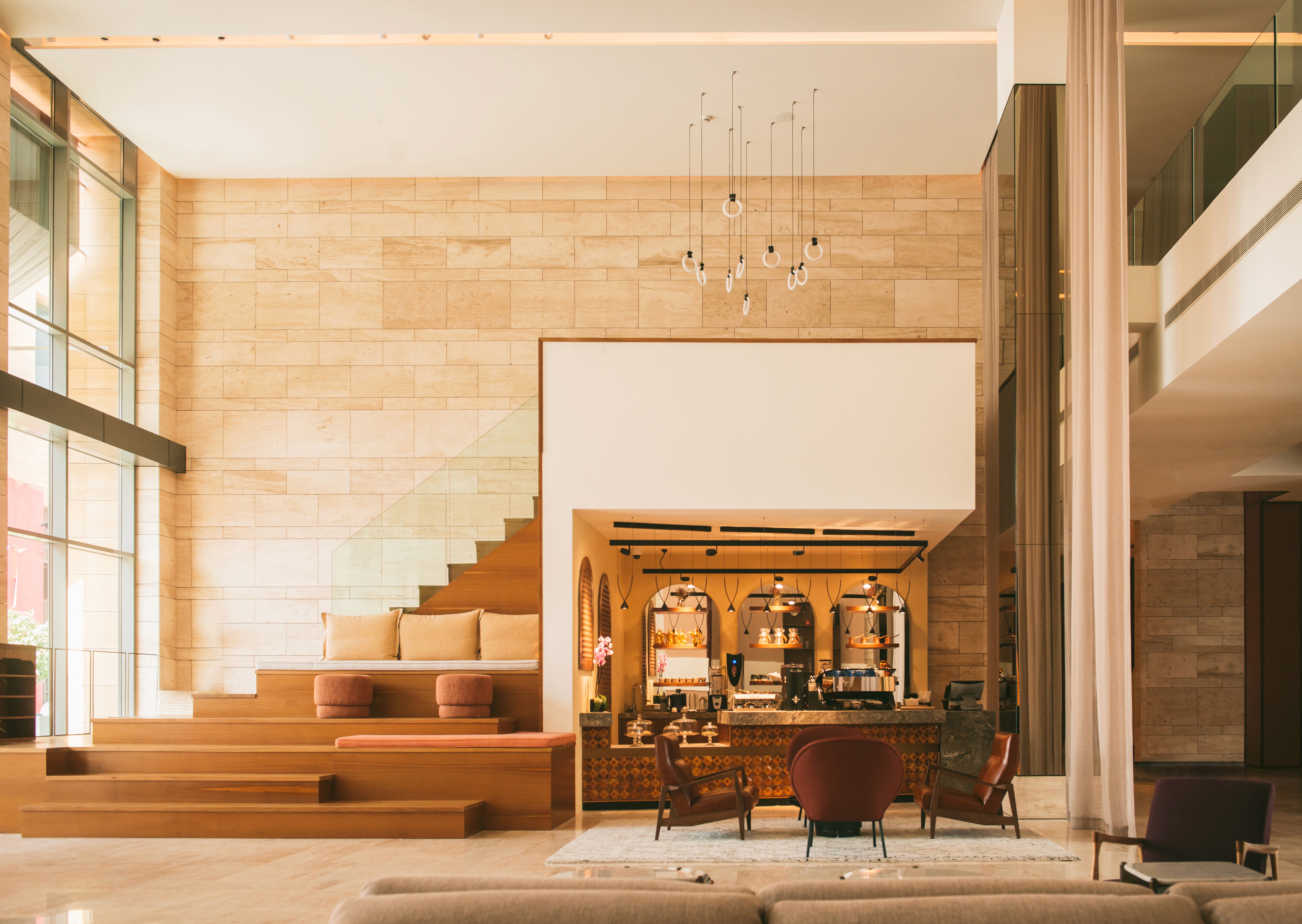
Two markets, two climates, two very different references. The same question was asked at the start of both projects: what does this place already know about hospitality?
What this means for developers and operators
Treat speed as a reason to slow down at the start. A compressed programme leaves no time to correct a concept later. Context & Research is the cheapest stage of a project to get right and the most expensive to skip.
Use the brand standard as a framework, not a concept. International standards are essential to how a hotel performs. They are not a reason for it to look like every other hotel of the same flag.
Specify for the real climate. Humidity on the Mekong Delta and dust in Riyadh are the conditions a building will live with for twenty years. Materials, finishes and FF&E should be chosen for those conditions before they are chosen for the opening photographs.
Bring local makers in at concept stage. Both Vietnam and Saudi Arabia have craft bases that can work at hospitality scale, but only with realistic lead times and early involvement.
Design for the guest you will actually receive. A family gathering after evening prayers in Madinah and a returning Korean couple in Da Nang need different public spaces, even under the same brand.
In phased destinations, design the first hotel for both stages. It has to work alone on opening day and as part of a larger place later.
Conclusion
"Dancing on the Global Stage" was a fitting theme for MTE Hanoi. Vietnam and Saudi Arabia are now competing for the same international operators, the same investors and, increasingly, the same travellers. The markets that will hold their value are the ones where hotels still belong to their places once the pipeline has been delivered.
Studio Noor has designed hospitality in Vietnam for twenty-three years and in Saudi Arabia since the Shirvan Hotel in 2018. If you are planning a hotel, resort or F&B project in either market, the studio's directors would welcome a conversation. Contact the studio directly: info@studionoordesign.com